From capture to inference

AI can already organize your notes. It gets interesting when it can infer the action items and push them through to done, with someone accountable for each one.
In 1854, John Snow traced a cholera outbreak in London to a single water pump on Broad Street. Edward Tufte retells the story in Visual Explanations as a case where the evidence was there all along, waiting for someone to organize it and make it visible. The map gets the credit, but the real work was weeks of door-to-door data gathering; the map was how Snow made the case, not how he found it.
Even then, the establishment clung to a different and incorrect theory. It took nearly 30 years and a citywide sewer project before science confirmed what Snow’s map already showed. The evidence took weeks to capture and a generation to accept.
We’re living in an era where the gap between capturing evidence and acting on it has collapsed. The inference ability of LLMs is what’s driving that speed. I’ve been experimenting with this at a small, personal scale.
This is the story of why I built Unicron, a Mac front end for my Claude Code second-brain skills. A second brain, if the term is new to you, is a store of everything you want to remember, kept outside your head in linked notes. The idea comes out of personal knowledge management and the tools-for-thought community, and its lineage runs deep, back through Doug Engelbart’s work on hypertext and augmenting human intellect to Vannevar Bush imagining the memex in 1945, a desk that would hold a researcher’s whole library as a web of linked ideas.
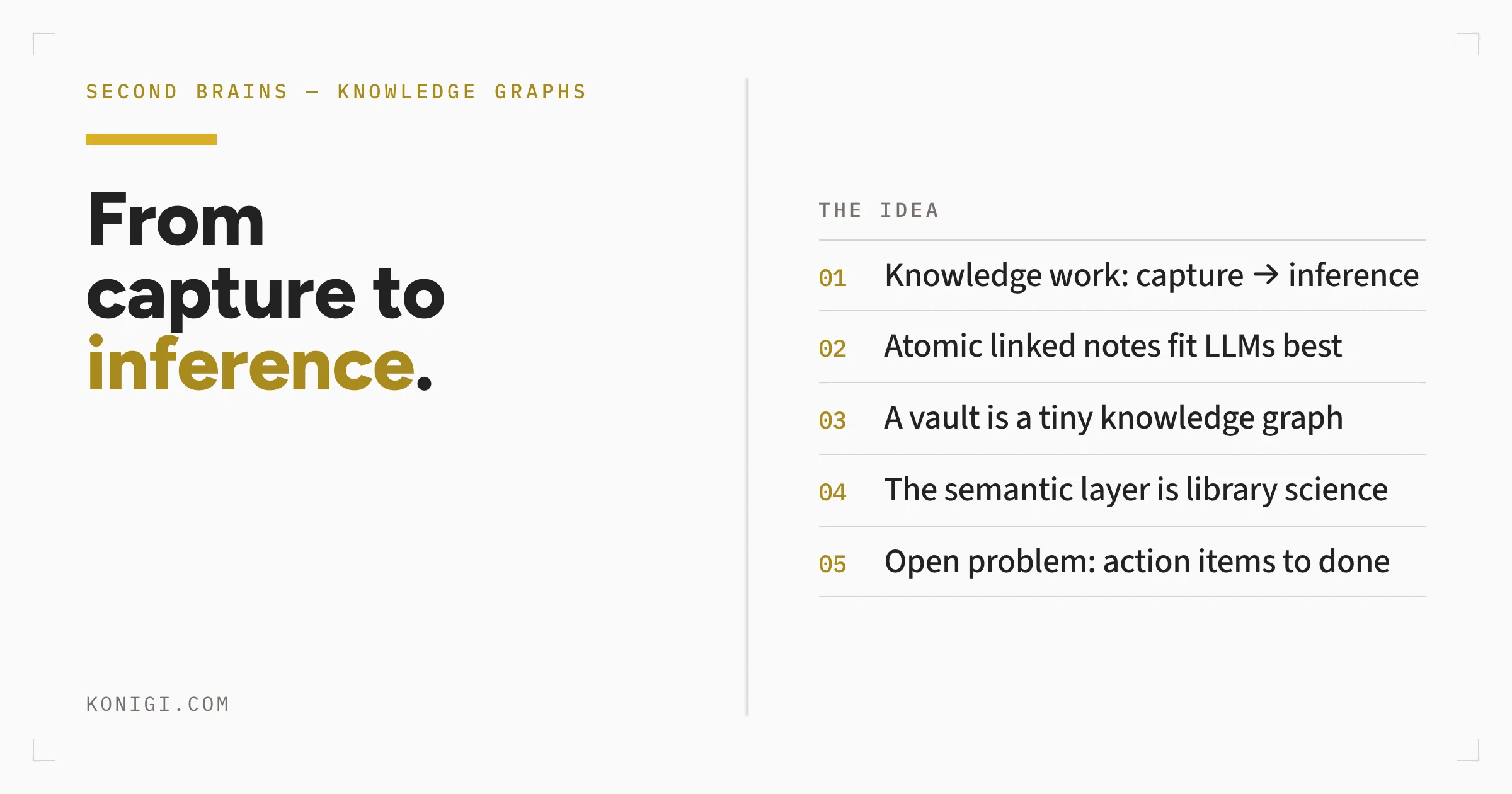
The shift from capture to inference
A lot of my day is spent on capture, analysis, synthesis, and tracking. This can look like researching a project, pulling action lists out of meeting notes, or reading through notes to find a detail I know I saved somewhere (but where?). All of it comes down to finding the right thing at the right moment to make a decision. It eats the day fast. And when capture is slow, or doesn’t happen at all, progress stalls with it.
The way we do knowledge work is changing now that LLMs can usefully describe the meaning of raw information. Hand one your meeting notes, a project brainstorm, your notes about a person, or any unstructured file, and you get back something organized and actionable. You show up ready to go to town on your action list, aware of what’s going on. This is the magic of inference.
It’s the natural evolution of the knowledge work I got into years ago, fresh out of an MLS program and working in digital libraries at Bell Labs. Back then I was a naive junior IA and front developer who began experimenting with alternative lightweight systems for knowledge management. I wrote articles in Library Journal and LLRX, and gave a talk at Los Alamos National Laboratory and Computers in Libraries about the frontier of knowledge capture using grassroots tools like blogs and wikis—things that gave access to anyone without locking them into cumbersome, esoteric systems. That was 20 years ago! Those ideas seem so quaint now. Those ideas about slow information capture and retrieval with heavy tools like federated search seem so quaint compared to what we can do today. Now the frontier has moved to passive capture and inference.
Enter Unicron
People are already building products on this shift. My entry is Unicron, a free Mac app that moved my initial Brain skills out of the terminal, with the Claude Code CLI as the engine. For now it’s a fast way to iterate on the idea.
The part that changes your relationship with your notes is that Unicron treats the vault of notes, the folder holding all your notes, as the agent’s memory. When the agent reads the vault before every daily brief and writes new notes back into it after every meeting, the notes stop being an archive and become the long-term memory of something that works alongside you. Local-first here means the files are plain markdown on your machine, portable and yours, with no lock-in. The inference runs on Claude in the cloud, so the data is yours even though the model isn’t.
There’s also an engineering reason plain markdown works so well. The second-brain crowd has always pushed atomic notes—short files that hold one idea and link heavily to their neighbors. That topology turns out to be close to ideal for an LLM. Hand a model a hundred-page document and it has to find the needle. Hand it a web of small linked notes and every retrieval comes back tightly scoped, with its context attached. Obsidian users were building the right data structure years before there was a model that could take advantage of it.
The same shape at enterprise scale
Companies are building the same thing, and the vocabulary changes when they do. My vault links a meeting note to a project note with a wikilink. An enterprise knowledge graph links a customer in the CRM to an order in the ERP to a thread in Slack, mapping the business as entities and relationships instead of files and folders. It’s the same shape with bigger nouns.
Where I get by with folders and tags, a company needs a semantic layer. Systems need a shared vocabulary so the model knows, for instance, that “gross margin” in a legacy spreadsheet and “profitability” in the new dashboard mean the same thing. This is the stuff of library and information science—defining terms, building controlled vocabularies, and mapping how concepts relate to each other. What’s funny to me is that it’s the work I trained for in the MLS program and did at Bell Labs, back when it felt like the least glamorous corner of the field. And now the importance of this work is cycling back into discussions. Seems the taxonomists were early.
Retrieval works differently on a graph, too. Plain vector search matches text that looks like your question, which is how you get confident answers assembled from the wrong context. GraphRAG makes the model follow the graph’s actual relationships instead, the way you’d click from note to note in Obsidian. Ask how a supply chain delay in Ohio affected your top three clients and it walks from the Ohio node to the delayed shipments to the accounts those shipments feed. That doesn’t make it hallucination-proof (nothing is), but the answer is grounded in connections that exist, and you can trace how it got there.
The idea runs in both directions. If you understand why a vault of small linked markdown files makes a personal agent useful, you understand the architecture enterprises are buying as a knowledge graph. Data that’s linked and defined before the model shows up is what makes inference trustworthy at any scale. And the problem I see at both scales is the same one.
You already see pieces of this in Granola, Notion, Otter, Zoom, and Meet, and plenty of companies talk about workflows that pull notes out of a dashboard into where the work actually happens, e.g. Jira, Asana, Notion. But I don’t hear many people talking about the part that interests me, which is not just organizing the notes, but forcing the action items through to done, with someone accountable for each one. That’s what’s I’m experimenting with in making Unicron.
Knowledge work has gotten exciting to me again. I am exploring opportunities to do really useful work in this space. I help teams structure their knowledge for AI inference. If you want to discuss where this is going, connect with me on LinkedIn or email me.
Mentioned in this article
- Visualization myths around Snow’s cholera map
- Unicron: my free Mac front end for Claude Code second-brain skills
- Claude Code: Anthropic’s agentic CLI, the engine behind Unicron
- Obsidian: local markdown vault with linked notes; the reference second-brain editor
- Granola: AI meeting notes captured locally on your Mac, no bot in the call
- Otter: meeting transcription and summaries across Zoom, Meet, and Teams
- Zoom AI Companion: Zoom’s built-in meeting summaries and action items
- Gemini in Google Meet: Google’s built-in meeting notes
- Notion: docs, wikis, and databases with AI layered on top
- Jira and Asana: where action items go to get done (or not)
- GraphRAG: Microsoft’s open-source graph-based retrieval project
- Visual Explanations: Edward Tufte’s book with the John Snow chapter
- LLMs shift knowledge work from capture to inference. Hand one your raw meeting notes and you get back something organized and actionable, which changes what a second brain can be.
- Unicron is a free Mac front end for my Claude Code second-brain skills. The agent treats the vault as its long-term memory, plain markdown files on your machine, portable and yours, with no lock-in.
- Atomic linked notes turn out to be close to an ideal data structure for LLM retrieval. Obsidian users were building it years before there was a model that could take advantage of it.
- A personal vault and an enterprise knowledge graph are the same shape with bigger nouns. The semantic layer that makes enterprise inference trustworthy is classic library and information science, and the taxonomists turned out to be early.
- Plenty of tools organize notes. The harder problem is pushing action items through to done, with someone accountable for each one, and that's what I'm experimenting with in Unicron.