Blog

MIT UID Teatime Blog

· Michael Angeles

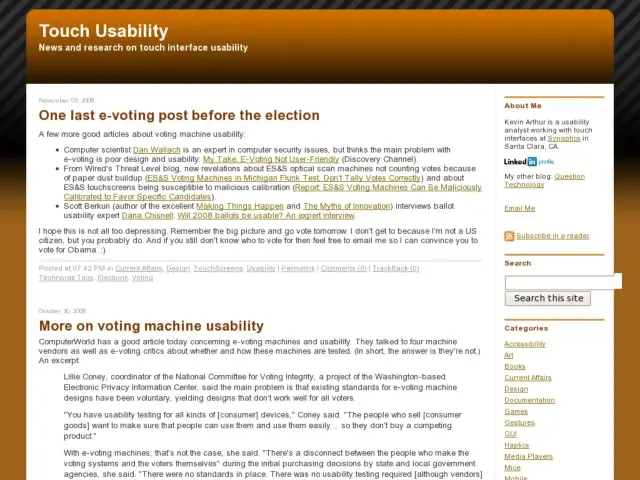
The User Interface Design Group at MIT has started their Teatime Blog. Info about the blog from entry #1:

The sharing of knowledge and ideas is of fundamental importance to the advancement of technology. With this goal in mind, MIT’s User Interface Design group meets once a day at Tea Time to brainstorm new ideas, review new technologies and ideas, and share their experiences working in the field.

If we hope to herald innovation by sharing ideas with a research group , then there’s a boundless value to sharing ideas and thoughts with the world at large. With this goal in mind, we will post a daily log of the musings and observations we discuss in our tea time meetings, and welcome your thoughts and comments about Human Computer Interaction, User Interface Design, and increasing the value and effectiveness of how we use technology
http://groups.csail.mit.edu/uid/teatime/?paged=2

50 Stunning Examples of a Great Redesign

· Michael Angeles

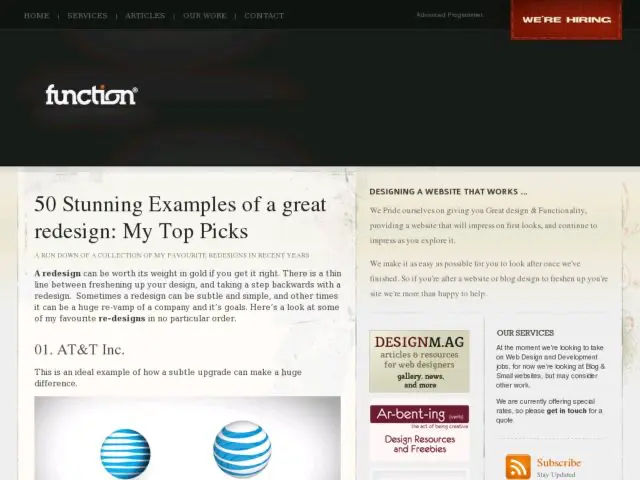
Function lists 50 great redesigns in a wide range of industries and product types from logos to automobile design.

A redesign can be worth its weight in gold if you get it right. There is a thin line between freshening up your design, and taking a step backwards with a redesign. Sometimes a redesign can be subtle and simple, and other times it can be a huge re-vamp of a company and it’s goals.

I don't agree with every redesign in the list, like AT&T, but this is a well thought-out and annotated compilation with some wonderful examples of brand and product transformations. Some are subtle, while others are dramatic. All transform the original in very creative ways.

http://wefunction.com/2008/10/50-stunning-examples-of-a-great-redesign/

GazoPa Image Search

· Michael Angeles

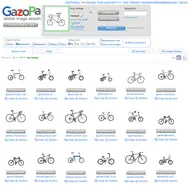
Gazopa provides image upload and drawing interfaces for image search. The idea of finding similar images by comparing against a submitted image or drawing is not new, but search tools that use this tech have failed to catch on in consumer sites. People with information retrieval background might be familiar with IBM's QBIC, query by image content, technology for instance.

Gazopa looks very interesting, and the results are not bad at all, even with my crude bicycle drawing above. The Flash drawing tool is a little rough around the edges, but I'm sure that will improve as well. Looks like one of the best attempts to bring this to the masses so far.

http://www.gazopa.com/

Product Planner - View and Create User Flows, Viral Loops, and More.

· Michael Angeles

Product Planner is one an brilliant idea. Deconstruct the user flow of web sites, illustrate the flow with annotated screenshot flowcharts, allow users to copy the flow and reuse on the site. Like Konigi, this does a great job of capturing examples of alternative approaches to interaction, showcases them for you to compare, and allows you to select the best examples to learn from and inform you of approaches you may not have thought of. Excellent.

Here's an example flow chart of a sign up loop.

Sign Up Loop - New

View more Twitter user flows.

http://productplanner.com/

Effectiveness of Brainstorming

· Michael Angeles

Found on smartex, and believed by jibbajabba to occasionally be true of group brainstorming...

Wikipedia on "Brainstorming".

Although brainstorming has become a popular group technique, researchers have generally failed to find evidence of its effectiveness for enhancing either quantity or quality of ideas generated. Because of such problems as distraction, social loafing, evaluation apprehension, and production blocking, brainstorming groups are little more effective than other types of groups, and they are actually less effective than individuals working independently.[2][3][4] In the Encyclopedia of creativity, Tudor Rickards provides the article on brainstorming, summarizing the controversies. He also indicates the dangers of conflating productivity in group work with quantity of ideas.[5]

2. Nijstad, B. A., Stroebe, W., Lodewijkx, H. F. M. (2003). Production blocking and idea generation: Does blocking interfere with cognitive processes? Journal of Experimental Social Psychology, 39, 531-548.
3. Diehl, M., & Stroebe, W. (1991). Productivity loss in idea-generating groups: tracking down the blocking effect. Journal of Personality and Social Psychology, 61, 392-403.
4. Mullen, B., Johnson, C., & Salas, E. (1991). Productivity loss in brainstorming groups: a meta-analytic integration. Basic and Applied Social Psychology. 12, 3-23.
5. Rickards, T., (1999) Brainstorming, M Runco & S Pritzker, Eds, Encylopedia of creativity, San Diego: Academic Press Vol 1 219-228.

http://twitter.com/smartex